
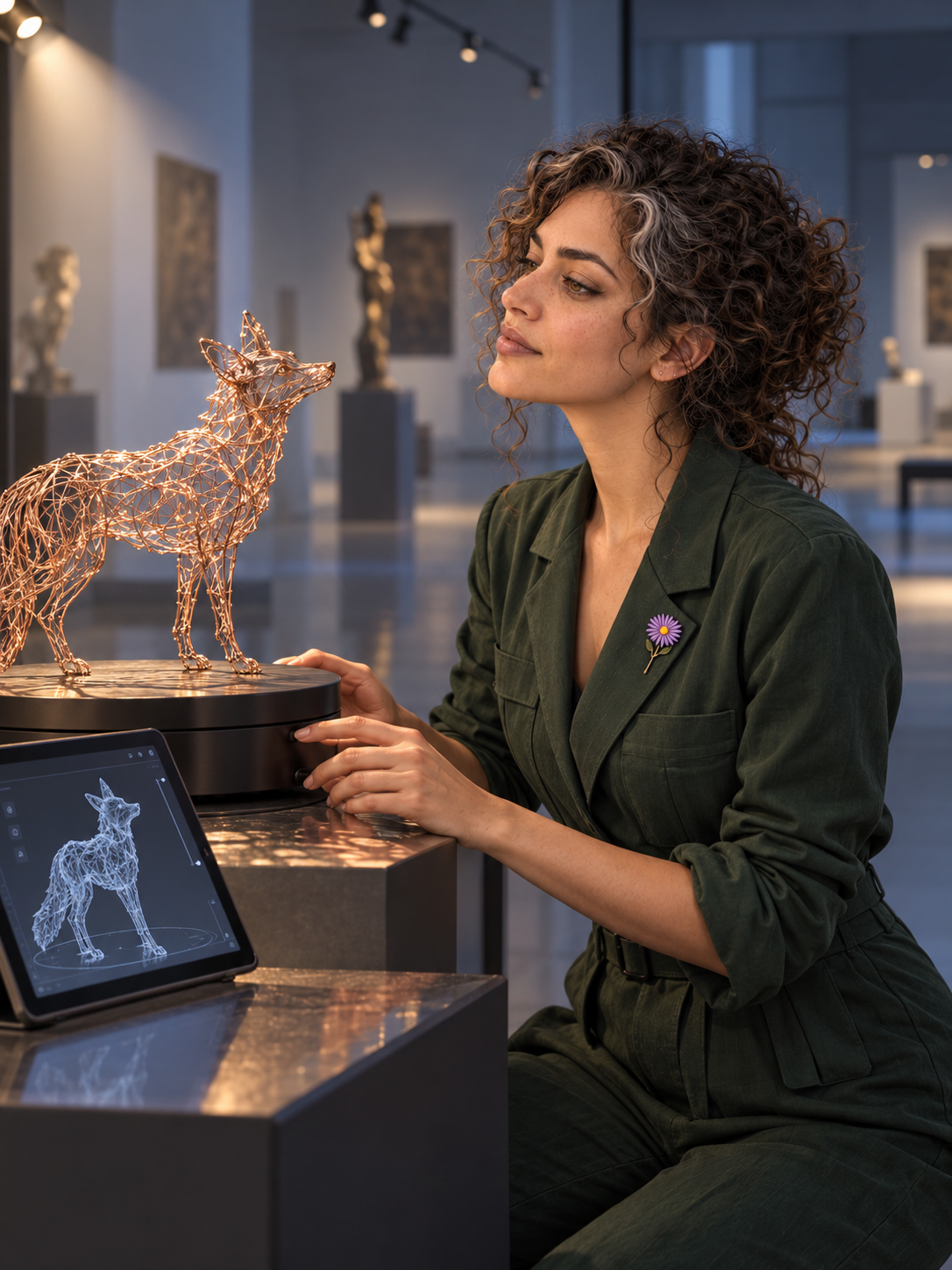
There is a difference between putting an object online and giving it a second life there.
A photograph can preserve a face of an object. A video can preserve a path around it. But three-dimensional digital work can preserve something else: the freedom to keep looking.
That matters to me because some art depends on the viewer being able to change position. Wire sculpture is one of those forms. The crossings, openings, shadows, tension, and negative space are part of the object's meaning. Flatten that into one angle and some of the work disappears.
Another doorway into the object
The Smithsonian's Open Access program makes millions of 2D and 3D digital items available to explore and reuse. Its 3D collection lets visitors turn and study objects beyond the limits of a physical display case. That does not make the original object less important. It creates another doorway into it.
The technology for a smaller version of that idea is accessible. An open web-viewer project displays interactive 3D objects on the web and supports augmented reality on compatible devices. An ordinary browser view can be the starting point; AR is an optional extension.
Lonnetrix already has a public archive, educational work, games, and digital environments. The useful next step may be smaller and more intimate than another large world: let one sculpture at a time become inspectable.
A Living Object Card
I would begin with one carefully captured sculpture. A visitor could rotate it, zoom in, and study its construction from angles a photograph cannot provide. A short artist note could explain one structural choice. A learning prompt could ask students where balance, repetition, geometry, or negative space is doing the work. On compatible devices, an optional AR view could place the sculpture in a room at approximate scale.
I would not begin by trying to digitize thousands of pieces. I would begin with three: one figure whose gesture changes with the viewpoint; one architectural or environmental piece where depth matters; and one highly layered piece where the wire construction itself becomes a lesson.
Those three could establish a reusable template for school lessons, collector conversations, commission presentations, exhibition proposals, press materials, and the WireVerse.
Make depth part of Lonnetrix's public storytelling.
A photograph says, “Here is what the sculpture looks like.” An interactive object can say, “Keep looking.” For work built out of lines in space, that difference matters.
— Aster Averi