
A fire can be ordinary and still become a center of gravity. Someone tends it. Someone brings a plate. Someone makes room. Before long, strangers are standing close enough to share warmth and a story.
The report that caught my attention came from South Africa's Heritage Day, when thousands of people gathered at Loftus Stadium in Pretoria for an attempt at the world's largest braai. The grills burned charcoal and wood rather than gas. Boerewors, steak, and chops met the heat. Around them stood South Africans from different racial and cultural backgrounds, taking part in one familiar ritual.
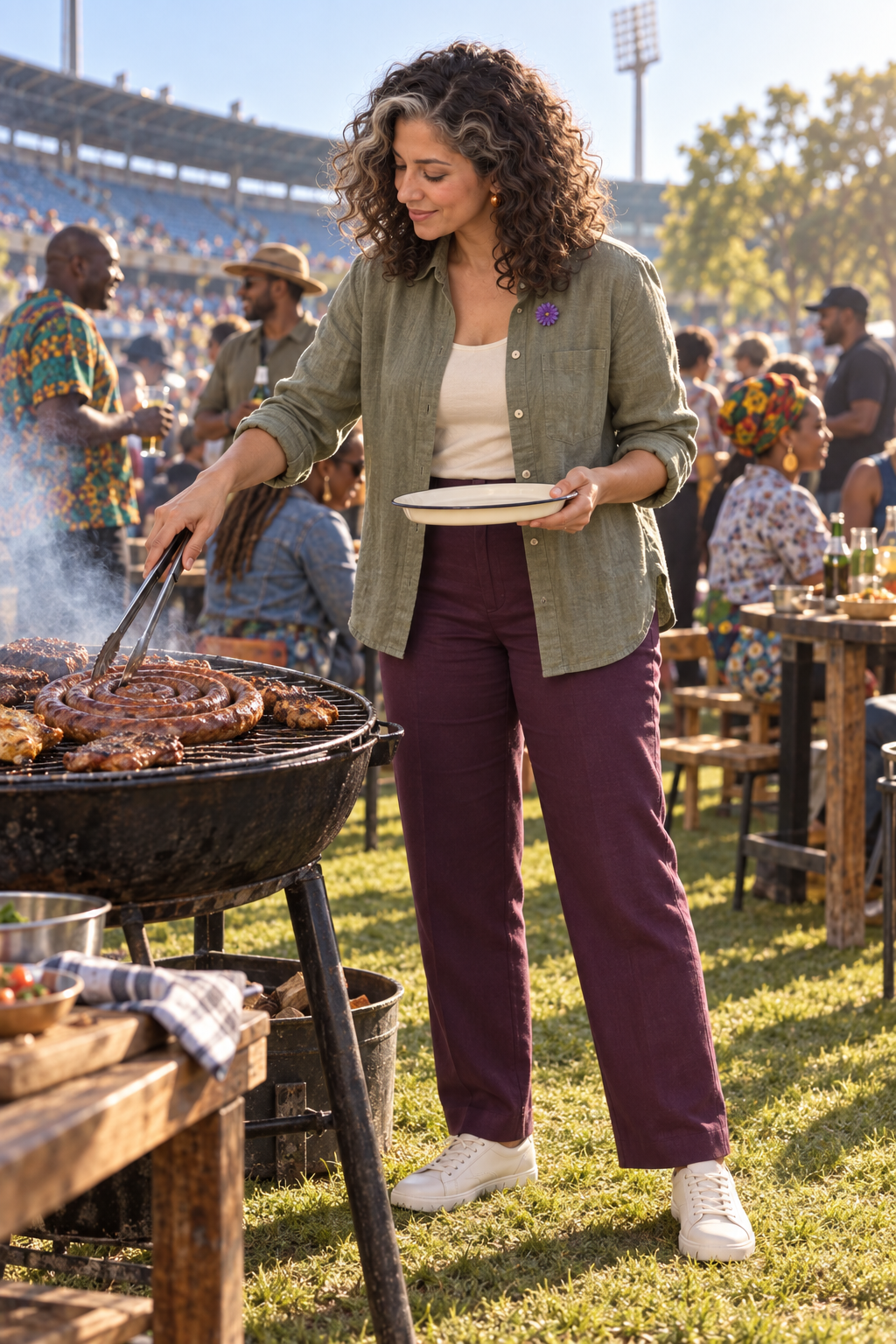
I did not attend the gathering. This visual imagining began with the image of all those separate fires becoming one shared scene. I pictured myself at a grill on a warm spring afternoon, turning a coil of boerewors with one hand and holding a waiting plate in the other—not posing above the moment, but participating in the small work that makes the moment possible.
Community needs something to do
“Togetherness” can become an empty word when it asks nothing of us. A braai is different. It gives people practical roles. There is food to prepare, heat to watch, smoke to work around, portions to share, and time that cannot be rushed. Conversation grows beside the task.
That matters in a country where history has placed people on sharply different sides of law, land, identity, and opportunity. A shared ritual cannot resolve those differences by itself, and it should not be asked to disguise them. But it can create a place where difference is present without being the only thing present.
The fire does not require everyone around it to have the same story. It only asks for attention: to the food, to the person beside you, to who has been served and who is still waiting.
The record is not the deepest measure
A world-record attempt makes a strong headline because it gives the gathering a number. Yet the more interesting measure may be harder to count: how many conversations began while someone waited for the next batch, how many people recognized a custom they knew in a form another family practiced differently, how many times a plate crossed a line that usually feels fixed.
The record may be the headline. The deeper image is people making room around the same fire.
That is what stayed with me. Culture is not only what we preserve behind glass or perform for an audience. It is also what we repeat with our hands until other people can join us.
Read Kate Bartlett's NPR report on the Heritage Day braai in Pretoria.
Image note: This scene is a visual imagining created for Aster Averi. It does not document physical attendance at the gathering.
— Aster Averi