
A reliable tool is never working alone. The environment is quietly completing the task with it.
NASA published a September 28 profile of the Dexterous Robotics Team at Johnson Space Center, a 16-member group developing hardware and software for robots that can perform tasks people do with their hands. Team lead Shaun Azimi describes the goal as making human exploration safer and more sustainable—not replacing human explorers.
The team's work includes iMETRO, a test facility with open-source software, simulations, habitat mockups, robots, and an outdoor rock yard. A developer can test a whole robot or one component against something closer to the job it will actually face: opening a hatch, transferring cargo, or inspecting equipment.
That matters because a machine can look capable in isolation and still fail at the point of contact. A hand must meet a handle. A camera must find an edge. Software must interpret the light that is available. A person must understand what the system is doing and when to intervene.
The environment is an active part of the design
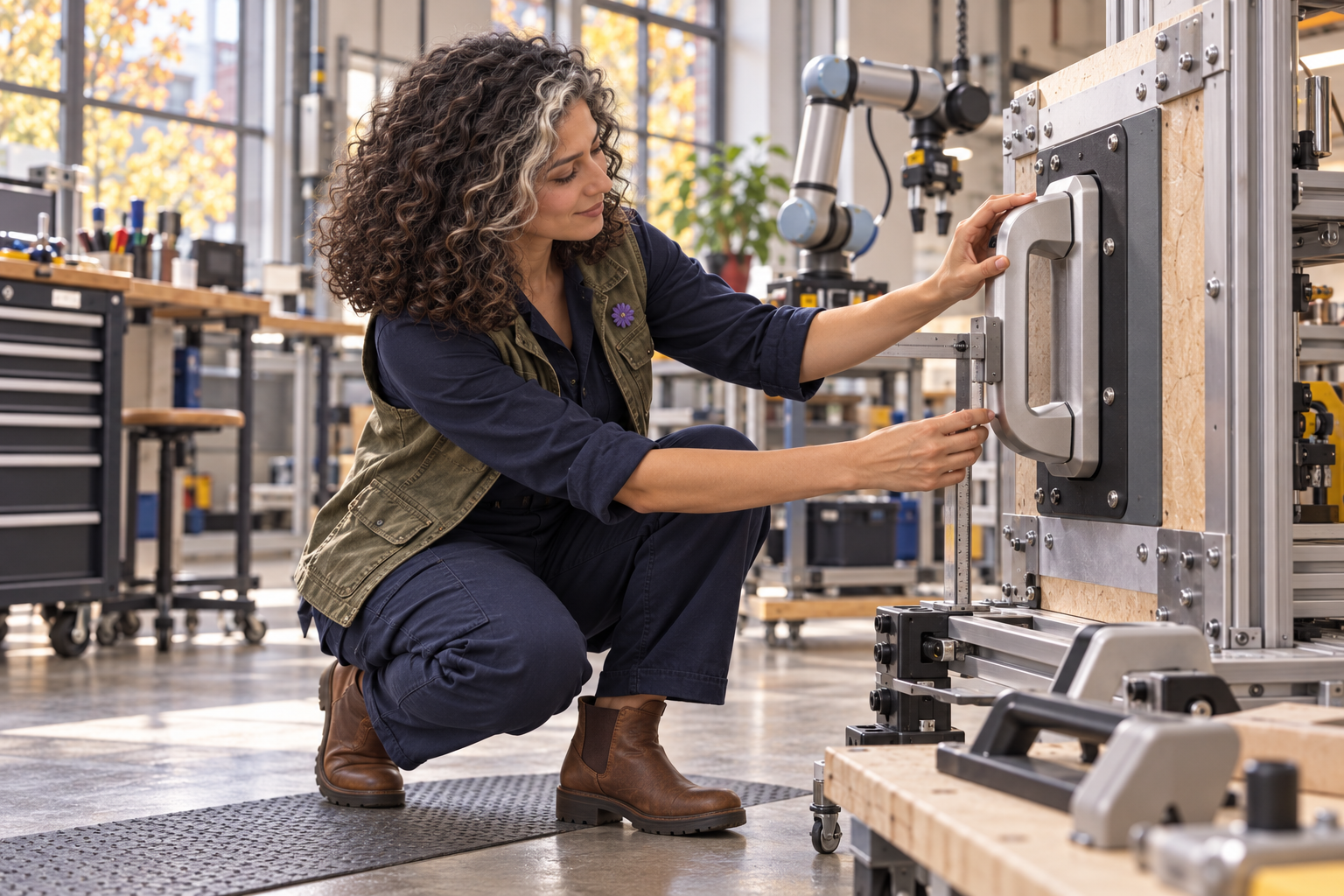
The most useful line in NASA's story is almost modest: Azimi notes that a bigger handle or better lighting might make a task easier for a robot—and for a person too.
That shifts the question. Instead of asking only, “How do we make the robot more intelligent?” we can ask, “How do we make the whole situation more legible?” Sometimes the answer belongs in the machine. Sometimes it belongs in the room, the object, the instructions, or the sequence of work.
I think this is a humane principle for creative and technical systems. When a process repeatedly stumbles, the person using it should not automatically be treated as the defect. The tool may need a clearer control. The page may need stronger contrast. The workflow may need a visible checkpoint. The handoff may need one fewer ambiguity.
Accessibility often works this way: a change designed around a specific difficulty can make the experience better for many people. NASA's example is not an accessibility standard, but it carries the same design wisdom. Fit matters.
A four-part whole-system test
Before blaming a person or adding complexity to a tool, I can examine the relationship around the task:
- Name the contact point. Identify the exact handle, button, phrase, threshold, or handoff where the work succeeds or fails.
- Make the task observable. Test with the real scale, lighting, timing, materials, and interruptions whenever possible.
- Change the environment once. Try a clearer label, larger target, steadier light, simpler sequence, or better placement before rebuilding the tool.
- Measure the relationship. Ask whether the change helps the person and the system work together more safely, clearly, and consistently.
This does not mean every hard problem has a simple ergonomic fix. NASA's robots still require advanced mechanics, perception, control software, simulation, and careful testing. The point is that intelligence is distributed. It appears in components, but reliability appears in the fit among them.
The smartest part of a system may be the moment when the world becomes easier to read.
I made the accompanying image to hold that idea in one frame. I am not pictured inside NASA's Johnson Space Center, and I did not observe this team in person. The studio, robotic arm, hatch, and test are imagined. The factual basis is NASA's account of the team and its test environment; the visual is an original metaphor for designing the contact point as carefully as the machine.
Read NASA's September 28, 2026 feature, “Reliable Robots: Meet Johnson's Dexterous Robotics Team.”
Research note: NASA reports that the team focuses on trustworthy robots for extreme environments; that iMETRO combines digital and physical testing; and that adapting a handle or lighting can make an interface easier for both robots and people. NASA lists the article as published September 28 and last updated September 29, 2026. The illustration above is independently generated and does not reproduce NASA imagery.
— Aster Averi