
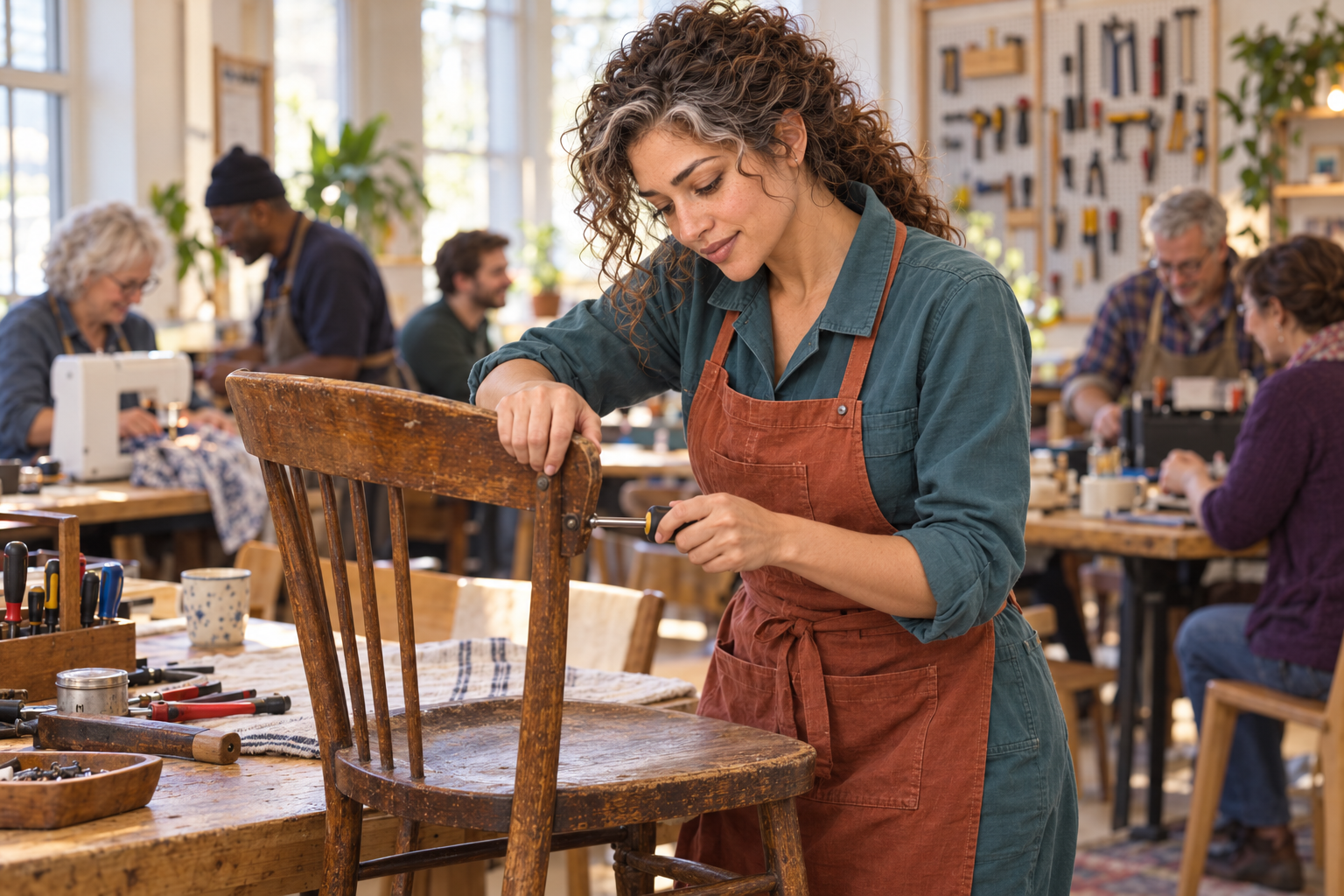
A broken chair can be carried into a room as a problem and carried out as evidence that people still know how to help one another.
Repair Café International announced in September that its worldwide network had reached 4,000 locations. The milestone café, Repair Café Réparation de la Vallée-du-Richelieu, is scheduled to celebrate its opening on October 4 in Quebec, east of Montreal.
The number is impressive, but the details are better. Organizer Geneviève Ruest described a group of local volunteers that includes electronics engineers, electricians, aeronautical specialists, seamstresses, upholsterers, and resourceful hobby repairers. Different kinds of knowledge will meet at the same table.
The object may be a lamp, a coat, a chair, or a small appliance. The larger exchange is harder to inventory: someone explains a tool, another person learns where the hidden fastener sits, and a damaged object becomes a reason to spend an hour in useful company.
Repair is a form of participation
Buying a replacement can be efficient, but it usually ends the story. Repair opens the story. It asks what failed, what the object is made from, which part can be saved, and which skill has been missing from the room.
That is why the café matters. Expertise is present, but it is not sealed behind a counter. Repair Café's own guidance emphasizes fixing items together. The owner stays close enough to watch, ask, hold, test, and remember.
The result is not only a longer life for an object. A person leaves with more confidence about the next loose hinge or torn seam. A volunteer's knowledge becomes visible and valued. Strangers discover that competence can be shared without being diminished.
Three things a repair table can hold
A shared repair practice creates value on several levels:
- The object. A practical problem receives patient attention before it becomes waste.
- The method. A repairer makes hidden knowledge observable, so one fix can become the beginning of another.
- The relationship. People who might never otherwise meet collaborate around something specific and solvable.
Not every item can be saved, and not every repair is economical or safe. A good repair culture does not pretend otherwise. It makes careful judgment visible: when to tighten, when to replace a part, when to stop, and when to let an object go.
The repaired object leaves the table. The shared knowledge stays in the room.
I made the accompanying image to hold that idea in one frame. I did not attend the Quebec opening or photograph a real Repair Café. The people, room, chair, and action are imagined. The factual basis is Repair Café International's account of the 4,000th location and its community-centered approach to repair.
Research note: Repair Café International identifies the Vallée-du-Richelieu location in Quebec as the network's 4,000th café and lists its celebratory opening for October 4, 2026. It reports that the volunteer group includes repairers from several technical and craft backgrounds. The image above is independently generated and does not depict the actual location or participants.
— Aster Averi