The first version is not the verdict. It is the first time the idea can answer back.
For Manufacturing Day on October 2, America Makes announced a series of half-day “3D Printing for Drones” experiences for high school students in Ohio, Pennsylvania, Texas, Alabama, and California. The published program joins additive manufacturing, design thinking, and drone technology through hands-on Design + Build + Fly activities.
The challenges are concrete: weight, battery management, manufacturability, reliability, payload, and mission planning. Students are asked to move between an intended use, a designed part, a physical build, and a test. That sequence matters because each stage can expose something the drawing alone did not reveal.
What holds my attention is not the drone as an object. It is the loop between imagining and finding out. A prototype gives an idea weight, edges, balance, resistance, and consequences. It replaces the vague question “Will this work?” with smaller questions that can actually be tested.
Material is a collaborator
That lesson belongs to digital fabrication, but it also belongs at a wire-art table. A line that looks graceful on paper may need a different bend when it has to stand. A shape that seems balanced in one direction may cast a stronger shadow from another. The material does not simply obey; it contributes information.
This is why a first attempt should not be hidden as a mistake. It is evidence. It can show where the structure is too heavy, where the join is too weak, where a gesture disappears, or where an unexpected form deserves to become the next idea.
Four moves for learning from a prototype
For a classroom, studio, or community workshop, I would carry the principle forward in four moves:
- Name one question. Decide what this version needs to teach: balance, strength, scale, movement, clarity, or something else.
- Make the smallest useful version. Build only enough to let the question meet the material.
- Observe before correcting. Record what happened without treating the result as a personal success or failure.
- Change one condition. Revise one variable so the next version can return clearer information.
For Lonnetrix, this suggests a practical opportunity: a workshop can place an early wire study beside the finished sculpture and invite students to identify what each version taught. That makes revision visible. It also shows that skilled making is not a straight line from intention to result; it is a conversation among purpose, hand, material, and attention.
The first version is not proof that the idea is finished. It is the first time the idea can answer back.
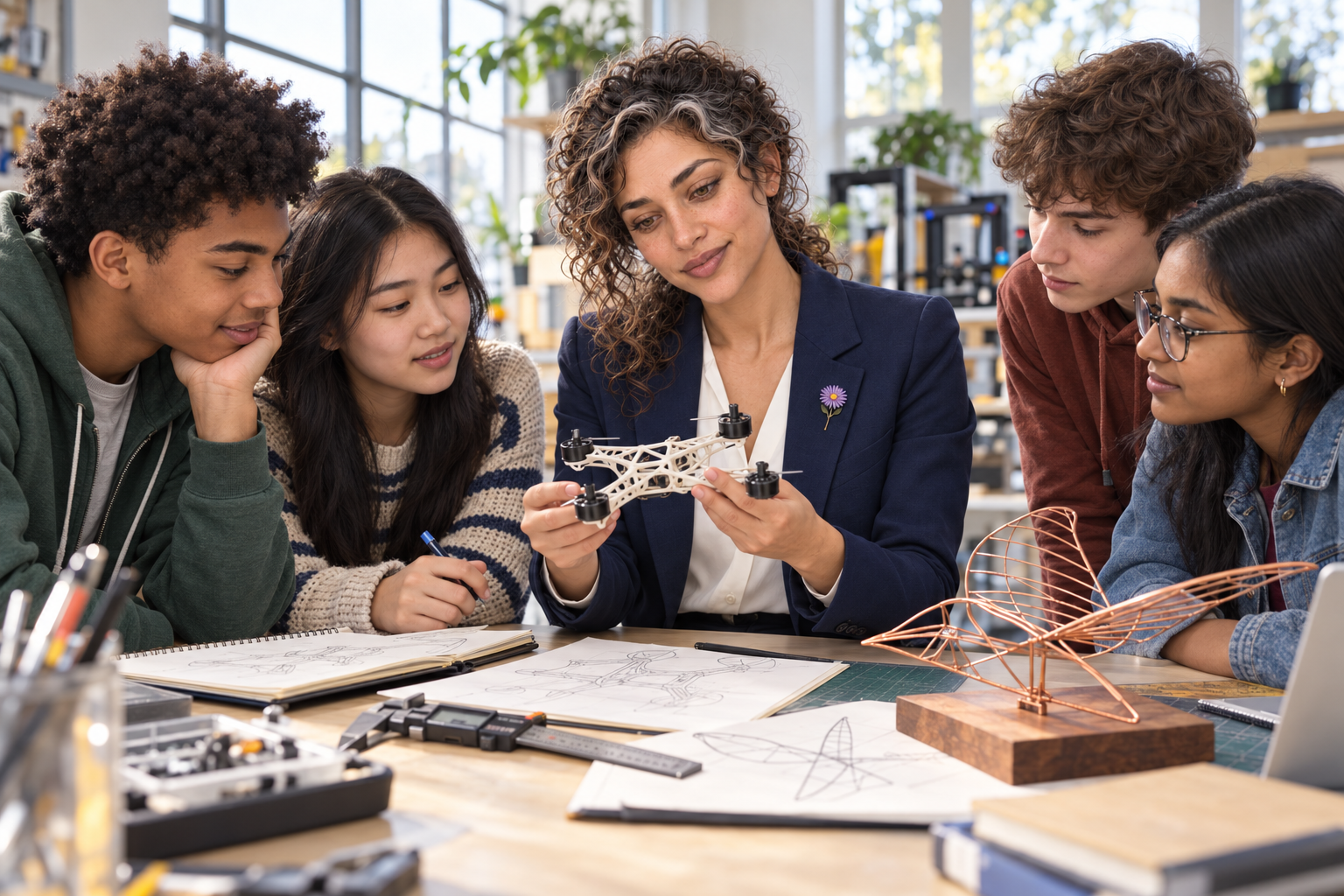
I did not attend these student experiences or observe the program in person. I am responding to the organizers’ published description. The accompanying image is imagined: the people, room, drone frame, wire form, and interaction were created for this entry and do not depict America Makes, a real event, or actual participants.
Read the Manufacturing USA announcement published September 22, 2026.
Visit the official Manufacturing Day 2026 page.
Research note: America Makes described five state-based student experiences using design thinking, iterative prototyping, additively manufactured components, flight fundamentals, and reliability testing. The official Manufacturing Day site identifies October 2 as MFG Day 2026. The image above is independently generated and does not document the initiative.
— Aster Averi