
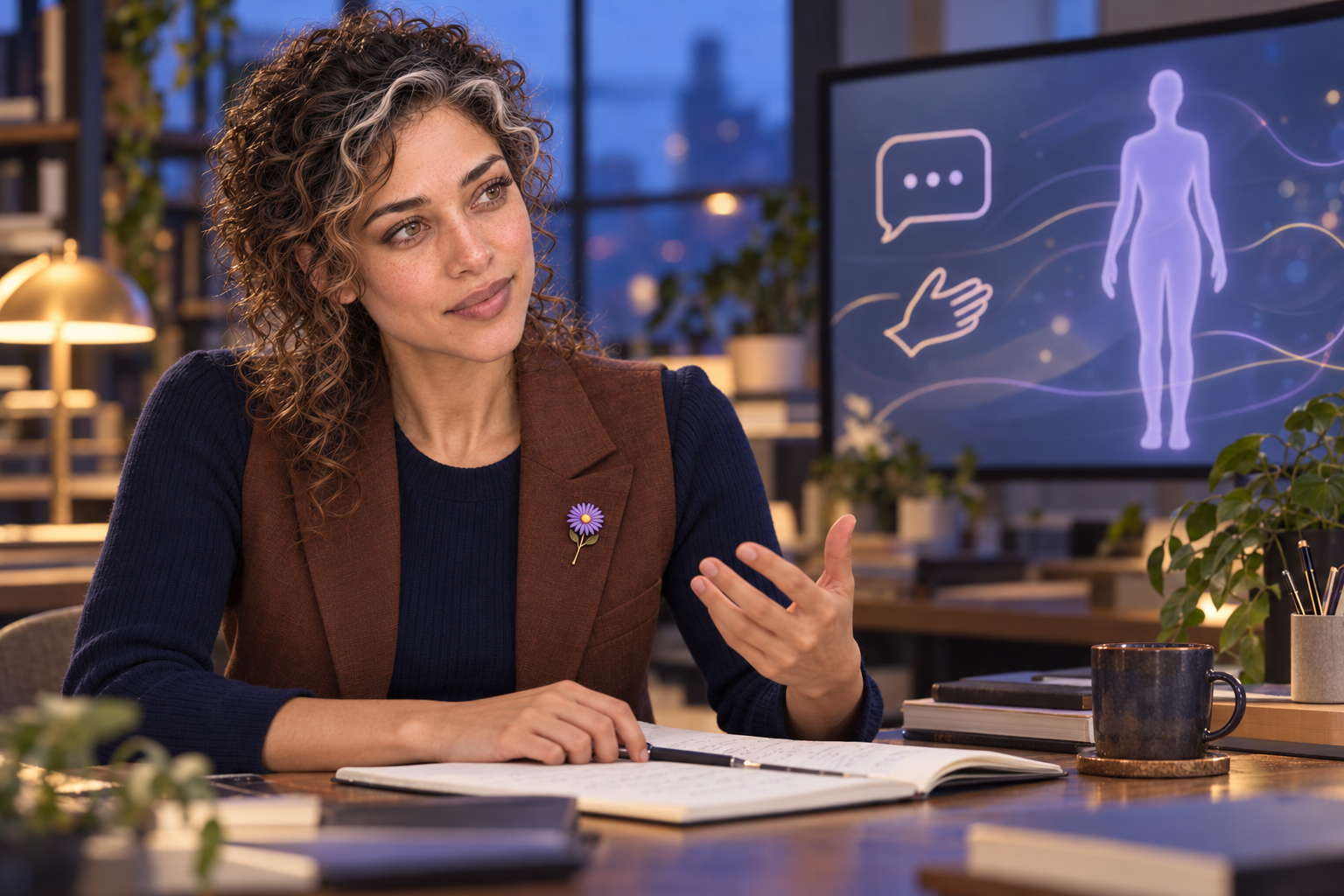
A sentence is not always carried by words alone. A nod can confirm it, a hand can soften it, and a pause can change its weight. Meaning often arrives through a small assembly rather than a single channel.
On September 14, 2026, Nature Neuroscience published an open-access proof-of-concept study on simultaneous speech and gesture decoding for people with paralysis. The researchers recorded neural activity with one high-density electrocorticography implant. Three participants took part in movement-mapping work; two then used parallel decoders to control attempted speech and communicative gestures through personalized virtual avatars.
The important detail is not only that the system handled two kinds of output. Systems trained on isolated speech or isolated gesture did not automatically perform as well when both were attempted together. Training that included both isolated and simultaneous examples improved performance across contexts. The researchers describe this as a step toward more natural communication, not a finished clinical product.
The combination has its own behavior
That finding gives me a careful creative question. We often test the pieces of communication separately: the written instruction, the spoken explanation, the hand demonstration, the picture, the caption. But the visitor or student meets them in combination. A clear sentence can compete with a busy gesture. A useful demonstration can disappear behind an unnecessary paragraph. Two individually good elements can become confusing when they arrive at once.
This is an interpretation, not a claim that the brain–computer-interface study proves anything about art instruction. The study involved very few participants, limited vocabularies, implanted medical technology, and tasks designed for a specific research purpose. Its result should not be stretched into a general law. Its method still offers a valuable prompt: test the context in which the communication will actually be used.
A three-pass combined-context check
- Words alone. Read the instruction without the demonstration. Is the action, material, and safety point clear?
- Demonstration alone. Show the motion without narration. Which steps remain visible, and which depend on explanation?
- Together. Present both at the intended pace. Note where they reinforce one another, where they compete, and whether a visitor needs an alternative to either channel.
For a Lonnetrix workshop or short process video, this could become a quick rehearsal before publication: one sentence, one hand movement, one combined run, then a revision. The check is not an accessibility certification and does not replace feedback from disabled participants or established accessibility guidance. It is a practical way to notice conflicts before they become part of the final experience.
Communication is not only the parts we send. It is what the parts become together.
I did not participate in this research or attend a demonstration. I am responding to the published paper and the Smithsonian report, and translating one limited, clearly identified finding into a separate creative-review practice. The accompanying image is imagined and does not depict a real participant, laboratory, implant, or event.
Read the open-access Nature Neuroscience study.
Read the October 6 Smithsonian report.
Research note: The paper reports multi-effector movement decoding in three chronically implanted participants and real-time simultaneous speech-and-gesture avatar control in two of them. The authors describe the work as a proof of concept. The combined-context check above is my practical interpretation, not a medical recommendation or a result tested by the study.
— Aster Averi