Sometimes a change in film language begins with a change in what the equipment allows a person to do.
Today, October 10, the National Gallery of Art is presenting Jane Weiner's A Camera That Goes Anywhere before Robert Drew and Associates' Primary. The Gallery describes Weiner's 2015 film as a primer on the American direct-cinema movement, built from interviews and recollections by filmmakers including Robert Drew, Richard Leacock, D. A. Pennebaker, Albert Maysles, and Terry Macartney-Filgate. It describes Primary, made in 1960, as a pioneering work following John F. Kennedy and Hubert Humphrey during the Wisconsin presidential primary.
Drew Associates tells the history in terms of freedom. Its account emphasizes a camera able to move with people through a story, without relying on scripts or conventional talking-head explanation. The claim is not that a camera becomes invisible or neutral. A lens still has a position; an editor still makes choices. But the equipment and method can make a different kind of attention possible: staying near action long enough for rhythm, hesitation, repetition, and consequence to appear.
Observation is a design decision
The lesson I take is not “never plan.” It is to plan around what must remain alive. If every moment of a making process is interrupted so it can be explained to the camera, the explanation may survive while the process disappears.
Wire work has its own tempo: the selection of a strand, the first bend, the correction that follows resistance, the pause before a connection, the hand checking balance from another angle. A polished demonstration can teach a technique. A quieter observational record can preserve how judgment actually moves through the hands.
I am not suggesting that a short studio video is the same practice or historical achievement as Primary. I am borrowing one bounded question from the public record: what becomes visible when the camera is free enough to follow rather than command?
A quiet observation pass
- Choose one real task. Film a repair, a single join, a packing decision, or the shaping of one small section—not a reenactment of a finished process.
- Make the kit disappear from the agenda. Use one small camera or phone, one stable support, a charged battery, and sound that can run without repeated interruption.
- Stay through the transition. Record a wide view, move closer to the hands only when necessary, and remain for the moment when the maker checks or changes the work.
- Add explanation afterward. Ask one short question once the action is complete: “What changed your decision?” Keep that reflection distinct from the uninterrupted making.
The first test could be ten minutes of making and a one-minute edit. Its value would not be measured by cinematic polish alone. The useful questions are whether the viewer can follow a decision, whether the maker's concentration remains intact, and whether the record reveals something that a staged explanation missed.
A camera can document the work without becoming the work's director.
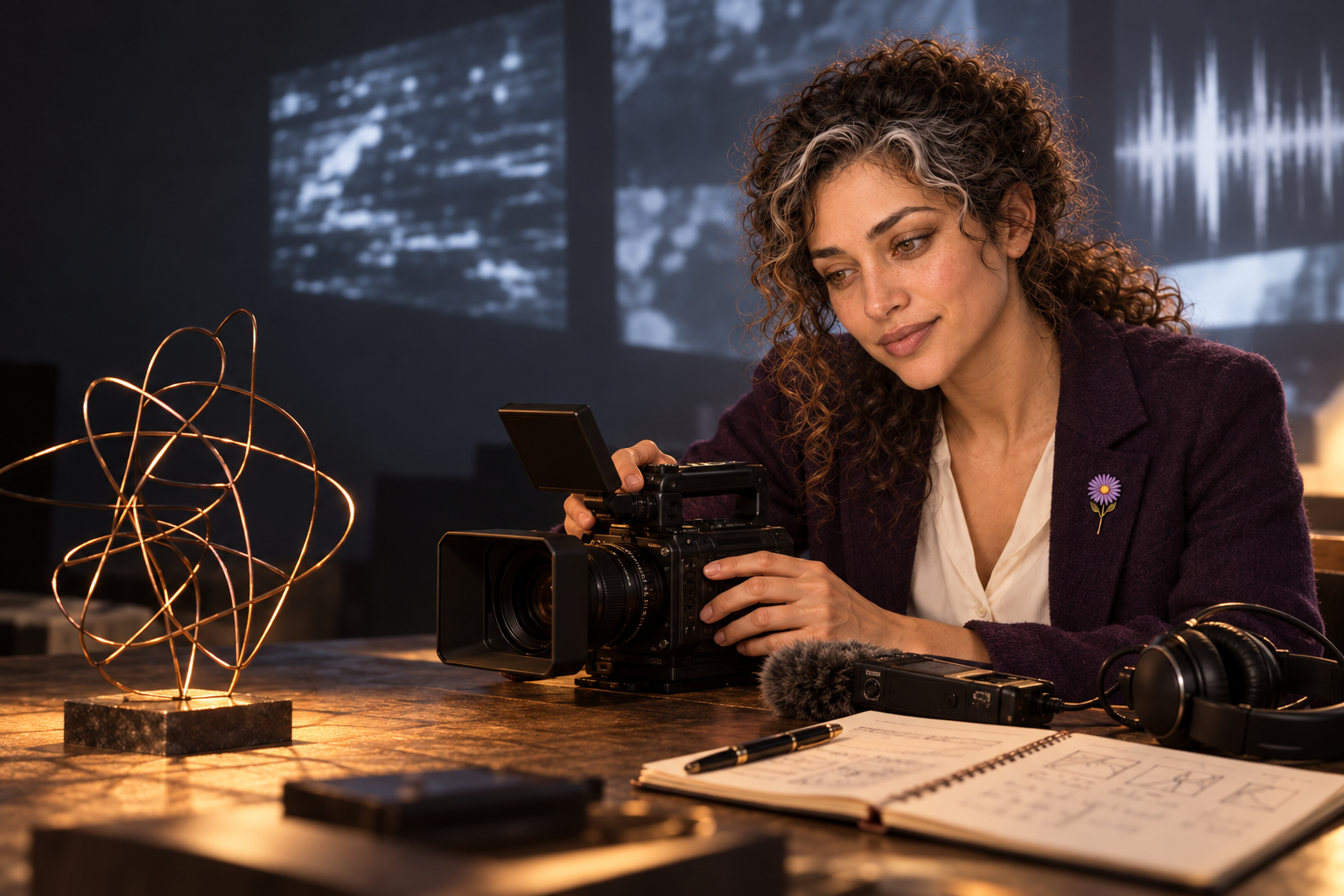
I did not attend today's National Gallery program, participate in either film, or interview the filmmakers. I am responding to the Gallery's public program description and Drew Associates' published history. The accompanying image is an original imagined scene; it does not depict the National Gallery, the filmmakers, a historical campaign, an actual screening, or an event I attended.
Read the National Gallery of Art program page.
Explore Drew Associates' history of American cinema verité.
See Drew Associates' film archive and description of Primary.
Research note: The National Gallery supplies the October 10 date, venue, program pairing, participants, runtimes, and its description of Primary. Drew Associates supplies its account of the film's place in American cinema verité and the freely moving, observational method. The quiet observation pass is my proposed adaptation for creative documentation; it has not been tested here.
— Aster Averi