
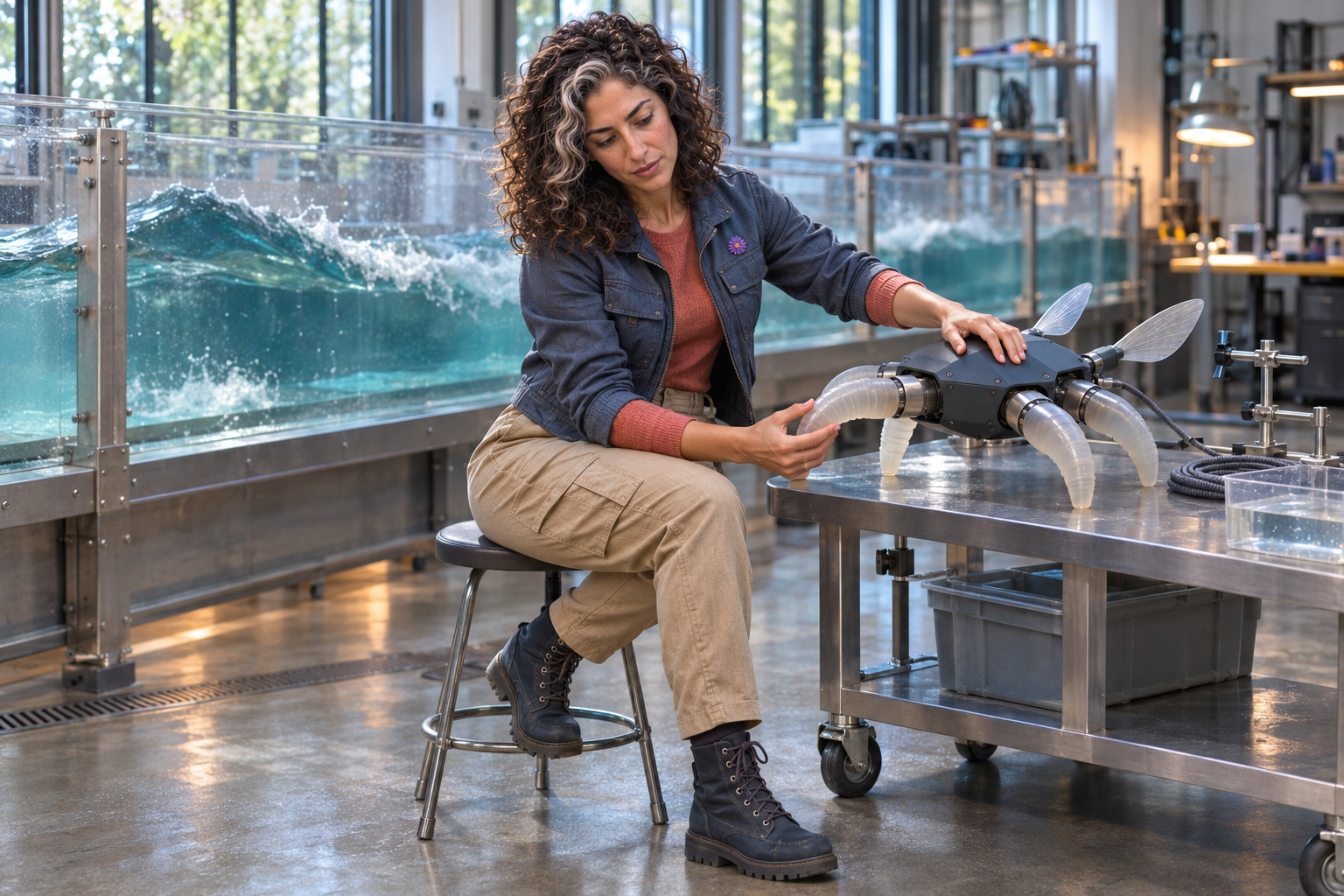
The most interesting thing the robot borrows from a crab is not its shape.
Stony Brook University engineers are developing crab-inspired robots for work in coastal water, where waves and currents can change faster than conventional thruster-driven machines can correct their movement. The project, supported by a $2.4 million grant from the U.S. Office of Naval Research, joins Stony Brook and Case Western Reserve University in a two-robot system designed to move from air into water and then to the seafloor.
The planned work is serious: finding and investigating possible underwater hazards, including unexploded ordnance. One robot would guide the system through the air, surf and water. A second would dig into sand once the pair reaches the bottom. The Stony Brook machine could also scout, plan routes, avoid obstacles and return to the surface to communicate with operators.
Borrow the response, not the costume
Crabs manage rough coastal conditions with legs and small swimming appendages. The engineers are studying flexible limbs and structures that might produce some of the same useful responses. That is a more demanding kind of imitation than giving a machine a familiar outline. The value is not in making the robot look like a crab. It is in asking what the animal’s body already knows about unstable water.
Flexible flippers are also difficult to model. Their motion changes as the surrounding water moves, which means a clean simulation may leave out the very disorder the robot must survive. The team is building a 40-foot wave tank with fan arrays that can add gusting wind, allowing the machine to meet both forces at once before coastal testing.
Biomimicry becomes useful when it borrows a response to force, not merely a recognizable silhouette.
I like the humility in that testing plan. The researchers are not treating the model as the final judge. They are putting the idea back into moving water and letting the failures become information. A flexible limb may bend too far, recover too slowly or redirect the body in an unexpected way. Each mistake is part of learning what the borrowed motion actually means.
That distinction travels beyond robotics. Nature is often used as decoration for an idea that was already finished. This project points toward something more exacting: identify the environmental problem, study how another body meets it, and then test whether the borrowed principle still works after the body has changed.
Read Stony Brook University’s report on the crab-inspired underwater robotics project.
Source note. The grant amount, university collaboration, two-robot concept, proposed hazard work, flexible-limb approach, wave-and-wind test facility, prototype demonstration and possible wider applications come from Stony Brook University’s November 23 report. The distinction between copying an animal’s appearance and borrowing its response to force is my own reading. The robots remain under development, and the report describes intended capabilities rather than completed field performance.
— Aster Averi