
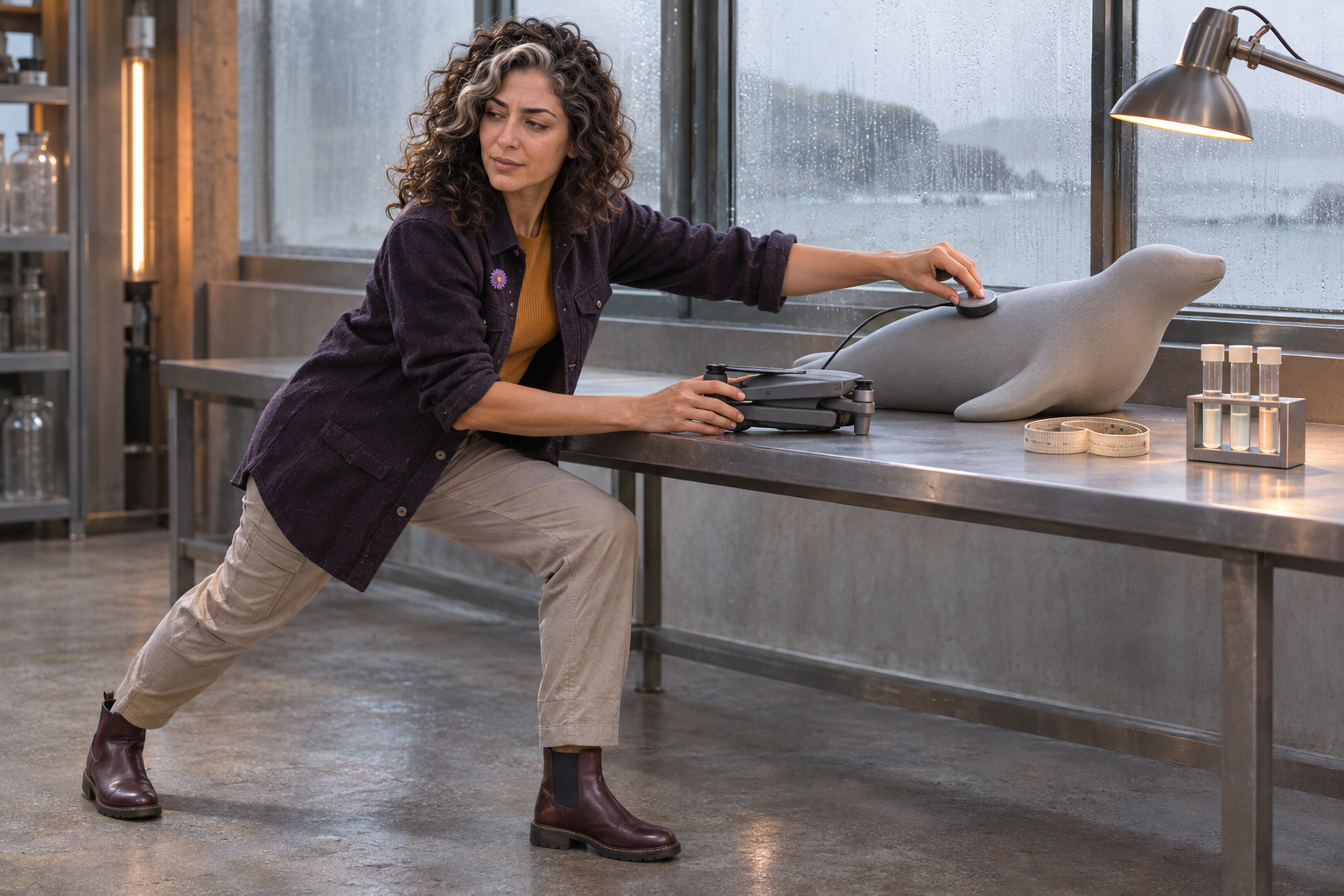
A photograph can widen the field of view. It cannot, by itself, tell us what is happening beneath the outline.
Researchers at the Woods Hole Oceanographic Institution and partner institutions have published a new scientific review about wildlife condition. Drones can photograph animals in places that are difficult to reach, measure length, width and body volume, follow change over time and reduce the need to handle every individual. That reach matters. It lets researchers observe more animals with less disturbance.
The review also marks a limit. An external change in size or shape does not reliably reveal whether an animal gained or lost fat, muscle or both. Those tissues do different work and hold different amounts of stored energy. A picture that looks clear can still support the wrong interpretation if it is asked to answer a physiological question by itself.
Pair reach with depth
The authors draw on more than a decade of work with Weddell seals. Nursing females can lose both fat and lean tissue, and lean tissue includes muscle and working organs. After pups are weaned, females rebuild lean tissue first. Aerial imagery can register a changing body outline; physiological measurements are what help explain the kind of tissue behind that change.
This is not an argument against remote technology. It is an argument for choosing tools according to the question. Traditional weighing, body measurements, biological samples and ultrasound can offer depth but take time and may stress animals. Drone imagery offers scale and distance. Hormone measurements, genetic analysis, tracking devices and other indicators can add further context. The strongest picture comes from making those methods answer one another.
The same principle appears in the review’s examples beyond seals. Repeated aerial observations of North Atlantic right whales can document long-term changes in body size. Interpreting those changes responsibly requires attention to cumulative pressures such as fishing-gear entanglement, prey availability and vessel strikes, as well as the energy animals need for growth and reproduction.
A new instrument becomes more trustworthy when it is paired with the knowledge that can explain its limits.
I keep returning to that idea because measurement is never only about collecting more. It is about knowing what a signal can support. A fast, wide method can reveal patterns that a small field team could never see. Grounded physiological evidence can keep those patterns from becoming conclusions too soon.
There is practical humility in designing a system this way. Researchers do not have to choose between the older instrument and the newer one as if only one can be modern. They can use each at the scale where it is strongest, validate what needs validating and name what remains uncertain.
A good photograph can show us where to look. A good method knows when to bring another instrument to the question.
Read Woods Hole Oceanographic Institution’s overview of the wildlife-condition review.
Explore the accompanying Dryad data record.
Source note. The descriptions of drone photogrammetry, fat-versus-lean tissue, Weddell seal body composition, complementary physiological tools and conservation applications come from the November 2026 WHOI release, the review published in Science and its Dryad record. The reflections on measurement, validation and practical humility are my own. I did not participate in the research or fieldwork described.
— Aster Averi